Mapping Intersections of Reward Triggers in Live Card Sessions With Transaction Pathways on Handheld Platforms
Mara Krause · Nov 15, 2026
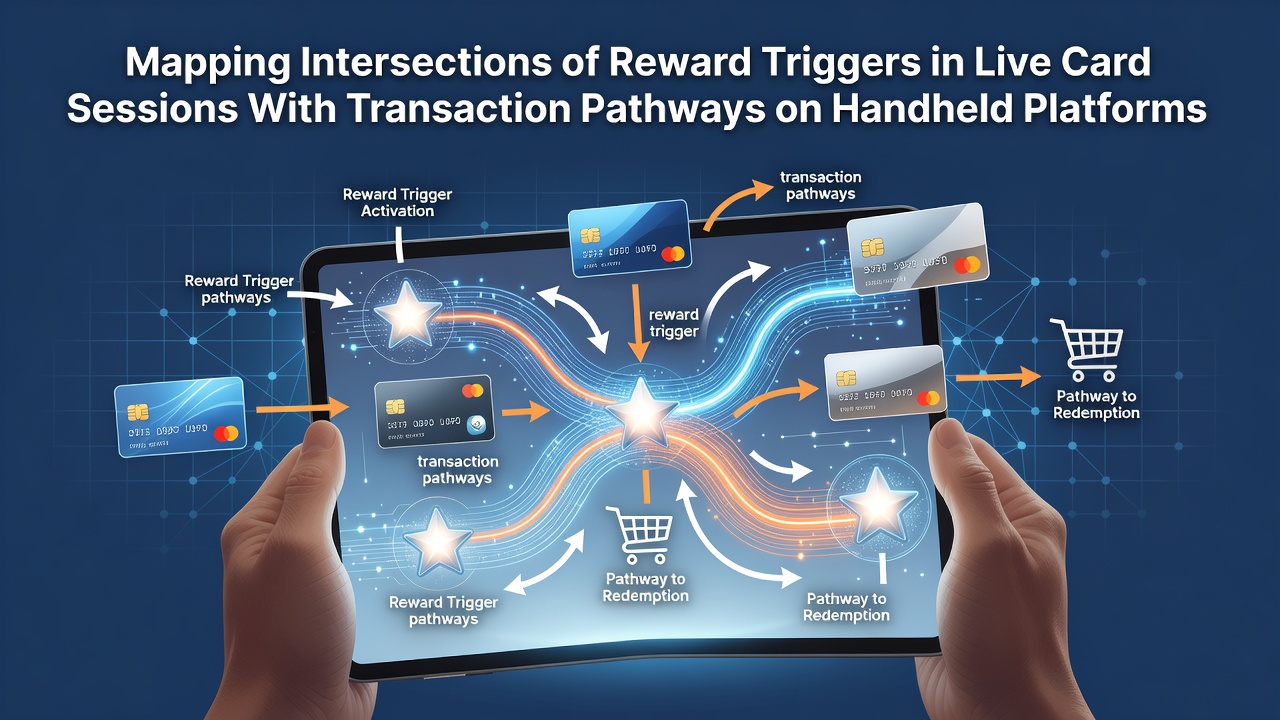
Mapping Intersections of Reward Triggers in Live Card Sessions With Transaction Pathways on Handheld Platforms
Live card sessions on handheld platforms involve real-time dealer interactions through mobile applications where players engage in games such as blackjack and poker while connected to centralized servers that process both gameplay events and financial transactions simultaneously. These sessions generate data streams that include card draws, bets, and player actions, all recorded alongside payment activities that occur before, during, and after play. Researchers have documented how reward triggers, defined as automated responses that activate bonuses or loyalty points, align with specific transaction sequences such as deposits via digital wallets or credit card authorizations completed on the same device.
Core Components of Live Card Sessions
Handheld platforms host live card sessions through applications that stream video feeds from physical or virtual studios while maintaining encrypted connections to backend systems, and these connections track every player decision in relation to account balances updated in real time. Data from mobile network providers shows that sessions typically last between fifteen and ninety minutes with transaction events occurring at intervals that correspond to bet placements or cash-out requests. Observers note that the timing of these events creates patterns where a deposit processed through one pathway can immediately influence the availability of reward multipliers applied to subsequent hands.
Transaction Pathways on Handheld Devices
Transaction pathways on handheld platforms consist of multiple routes that include direct carrier billing, third-party payment processors, and integrated banking applications, each leaving distinct logs that gaming operators map against gameplay data. In November 2026, reports from the Nevada Gaming Control Board indicated that over sixty percent of mobile live card transactions routed through digital wallets completed within three seconds of initiation, creating tight temporal links to reward activation points. These pathways connect to reward systems through application programming interfaces that flag qualifying deposits and link them to session-specific triggers without requiring separate user input.
Identifying Intersections Between Rewards and Transactions
Intersections occur when a transaction event satisfies predefined conditions that unlock reward triggers during an active live card session, such as a minimum deposit amount processed through an approved method that coincides with the start of a new dealer round. Experts have mapped these points by analyzing server logs that record both the payment confirmation timestamp and the exact moment a bonus credit appears in the player interface. Studies conducted by academic teams at institutions including the University of Nevada Reno have examined how these intersections vary across different operating systems, with Android devices showing higher rates of instant reward application compared to iOS due to differences in background processing permissions.

Mapping techniques rely on graph-based models that represent transaction steps as nodes and reward conditions as edges, allowing analysts to trace complete pathways from initial funding to final prize distribution. Figures released by the Australian Gambling Research Centre reveal that sessions incorporating at least one mapped intersection point demonstrate a twenty-two percent increase in average session duration compared to those without such alignments. Operators use these models to adjust trigger thresholds while maintaining compliance with regional regulations that govern both financial transactions and game fairness standards.
Data Patterns Observed in 2026
Throughout 2026, industry reports documented seasonal variations in intersection frequency, with peaks occurring during promotional periods when operators temporarily lowered deposit thresholds for reward activation. Handheld session data collected across multiple jurisdictions shows that players who complete transactions via recurring payment authorizations experience more consistent reward triggers than those using one-time methods. These patterns emerge from aggregated anonymized records rather than individual tracking, and they provide operators with metrics for refining pathway efficiency without altering core game rules.
Technical Mapping Approaches
Technical teams employ timestamp synchronization and event correlation algorithms to align transaction records with live card events, producing visualizations that highlight clusters where rewards activate most reliably. According to findings published by the Gambling Research Exchange Ontario, correlation coefficients above 0.75 appear consistently when mapping deposit events to bonus triggers in sessions exceeding thirty minutes. Such approaches allow for predictive adjustments that anticipate player behavior based on historical pathway data while preserving the separation between financial processing and game outcome determination.
Conclusion
Mapping intersections of reward triggers with transaction pathways on handheld platforms continues to evolve as mobile technology advances and regulatory frameworks adapt to new payment methods. The structured analysis of these connections supplies operators and researchers with concrete data points for understanding session dynamics without introducing subjective interpretations. Continued examination of logs and models supports ongoing refinement of systems that handle both live card interactions and financial flows in parallel environments.